Karpathy 的 AI 能力漏斗:为什么人们看到的是不同的世界
从偶尔聊天到长期运行的智能体,使用者之间的距离由什么造成?沿着 Karpathy 的四层观察,读清任务规模、能力分布与访问权限,以及人的验证为什么越来越重要。中英文对照。
阅读位置仅保存在当前浏览器;再次打开时可选择继续。

封面为 AI 生成的编辑插画,用于表达原帖的漏斗比喻。 / AI-generated editorial illustration of the post’s funnel metaphor.
背景:大家说的可能不是同一种体验 / Context
有人把 AI 当成偶尔帮忙改写文字的聊天框,有人已经把复杂的软件任务交给智能体持续执行。双方都在谈“大语言模型”,但他们接触的系统、任务和工作方式可能相差很远。
Some people experience AI as a chat box that occasionally rewrites text. Others use agents to carry out complex software tasks over time. Both are talking about large language models, yet their systems, tasks, and ways of working may be very different.
Andrej Karpathy 在这则帖子中重新提起自己四月份的观察:人们对 LLM 能力的共同理解正在进一步分化。他用一个越来越窄的漏斗描述这种差距——大量人几乎没有接触,一部分人偶尔使用,少数人深入工作,更少数人接触内部前沿系统。帖子的重点,是解释这些体验为什么会在同一时刻并存。
In this post, Andrej Karpathy returns to an observation he made in April: the gap in shared understanding of LLM capability is widening. His funnel runs from people with almost no contact, through casual and professional use, to a very small group with internal access. He is explaining why these experiences coexist at the same moment.
漏斗的四层,各自看见了什么 / Four different experiences
先读数字的口径: 以下人数与占比均为 Karpathy 的粗略估计,用来说明体验分布。他没有在帖中给出统计方法,不能据此当作人口调查,也不宜把这些组别相加为完整、严格互斥的全球分布。
How to read the numbers: All figures below are Karpathy’s rough estimates, intended to illustrate the distribution of experience. The post supplies no statistical method. They should not be treated as survey results or added together as a complete, strictly exclusive global breakdown.
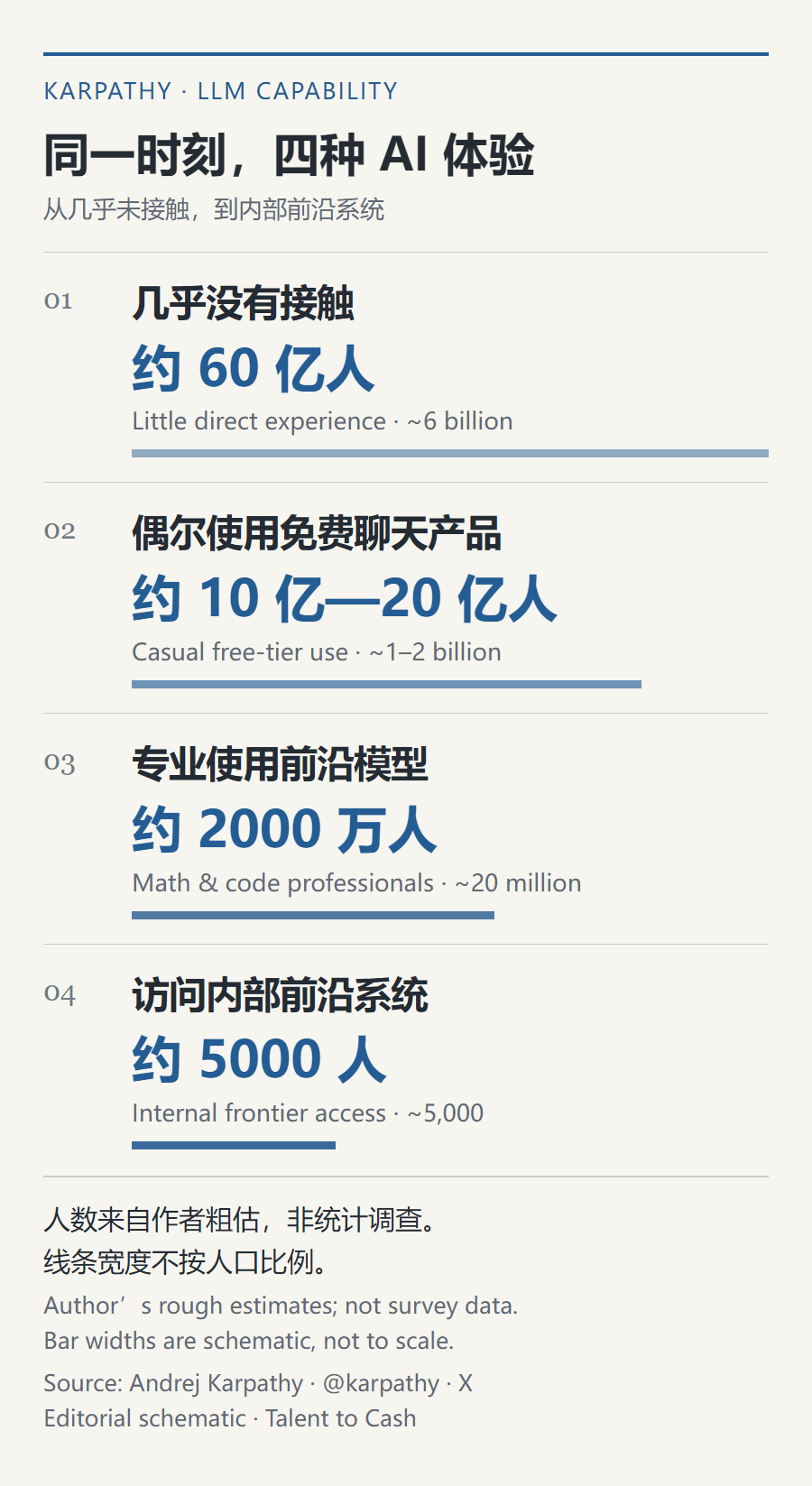
图:根据原帖制作的编辑示意。宽度不按人口比例;漏斗层次表示接触和使用方式,不表示人的能力或价值。 / Editorial schematic based on the post. Widths are not proportional to population; levels describe access and use, not people’s ability or worth.
第一层:几乎没有直接经验。约 60 亿人,约 75%。
按他的估计,最大的一群人几乎没有接触过大语言模型。对这群人而言,AI 的能力主要存在于新闻和别人的叙述中,还没有成为可以亲自判断的日常经验。
Little direct experience: about 6 billion people, roughly 75%. In his estimate, the largest group has barely encountered LLMs. Their understanding comes mainly through news and other people’s accounts, rather than direct everyday experience.
第二层:偶尔使用,看到的是聊天工具。约 10 亿至 20 亿人,约 20%。
这群人偶尔使用免费版 ChatGPT 一类产品,把它当成更方便的搜索、写作辅助,或尝试让智能体处理订机票这样的事务。Karpathy 特别提到,许多数学和编程领域之外的专业人士也在这一层。高管等岗位大量时间用于与人沟通,即使理解技术变化,对其工作影响的认识仍可能是间接、抽象的。因此,一个人说“我暂时用不上”,未必是不懂技术,也可能是工作尚未与模型擅长的任务相遇。
Casual use: about 1–2 billion people, roughly 20%. These users occasionally use free ChatGPT-like products for search, writing, or an agent-assisted booking. Karpathy includes many professionals outside math and code here. Executives, for instance, spend much of their time communicating with people, so their understanding of AI’s impact may remain indirect and abstract. Seeing little immediate use can reflect a mismatch between daily work and the tasks models handle well.
第三层:把前沿模型放进专业工作。约 2000 万人,约 0.2%。
Karpathy 认为,数学与编程领域的一小部分使用者,已经亲眼看到智能体完成过去需要数周、数月的复杂项目。他列举的任务包括构建应用、复刻应用、翻译应用,以及从二进制程序反编译。他还用自己的变化强调速度:不到一年前,自己仍主要在编辑器里逐字写代码、偶尔按 Tab 补全。
Professional use of frontier models: about 20 million people, roughly 0.2%. Karpathy says a small group working in math and code has seen agents complete complex projects that previously took weeks or months. His examples include building, copying, translating, and decompiling applications. He emphasizes how recent the change feels: less than a year earlier, he was still typing code manually and occasionally using Tab completion.
这里描述的是作者观察到的能力跃迁,不是“任何项目输入一句话就能交付”的保证。原帖没有给出这些项目统一的成功率、成本或验收口径。
This describes a shift he has observed, not a guarantee that any project can be delivered from one prompt. The post gives no shared success rate, cost, or acceptance criteria for these examples.
第四层:接触内部前沿系统。约 5000 人,约 0.00006%。
在最窄的一端,Karpathy 描述的是另一种运行规模:成千上万个智能体协作数周,处理大型软件、网络攻防、科学和数学问题。他认为,有些工作若由顶尖专业人士承担,原本需要数年;而人的审阅与理解已经开始跟不上系统产出的速度。这些属于作者对内部前沿系统的描述,不能直接等同于公开产品已普遍具备、并经过独立验证的能力。
Internal frontier access: about 5,000 people, roughly 0.00006%. At the narrow end, Karpathy describes thousands of agents collaborating for weeks on large software, cybersecurity, science, and mathematics tasks. He argues that some would previously have required years of expert work, while human review and comprehension are beginning to lag. These are his descriptions of internal systems, not independently verified capabilities generally available in public products.
为什么差距会扩大 / What drives the funnel
一、任务的规模和时间跨度,会改变你看到的价值。
Karpathy 的第一个解释是:一个用一段话就能答完的问题,几乎没有充分调动系统。任务越有挑战、范围越大、持续越久,使用者越可能看见不同于普通聊天的作用。因此,他强调要有一批自己真正关心的困难问题。这里的“野心”首先是任务设定:让模型参与值得解决的问题,而不只是反复把同一个短问题换种问法。
1. Problem size and time horizon change the value you encounter. A question answered in one paragraph barely stretches the system, Karpathy argues. More ambitious, larger, longer-running tasks can reveal uses that casual chat does not. His emphasis is on having a reservoir of difficult problems that matter to you. Ambition starts with the task being attempted, rather than repeatedly rephrasing the same small question.
二、能力有高峰和低谷,不会平均覆盖所有职业。
他用“参差不齐”描述模型能力:数字化、结果可验证、具有经济价值的领域更容易出现高峰。他把这种分布与基于可验证奖励的强化学习,以及受商业潜力影响的训练环境选择联系起来。这个解释说明了他为什么特别强调数学和代码;它是作者对能力分布的判断,不能据此推导出模型在所有领域都同样可靠。
2. Capability is uneven across domains. Karpathy describes peaks in work that is digital, verifiable, and economically valuable. He connects this pattern to reinforcement learning with verifiable rewards and to training environments selected partly for revenue potential. This is his explanation for the prominence of math and code, not evidence that models are equally reliable in every field.
这也解释了为什么不同职业的反馈可以同时成立:一个人在能快速检查答案的数字任务中感到变化很大,另一个人在依赖人际沟通的工作中只感到有限帮助。单一场景的成功或失望,都不足以代表整条能力曲线。
It also explains how different professional experiences can coexist: a person working on digital tasks with checkable answers may see a major shift, while someone whose work depends on interpersonal communication may see a smaller benefit. Success or disappointment in one setting does not describe the entire capability curve.
三、能接触到什么系统,本身就是差异的一部分。
免费、付费和内部访问,是原帖指出的第三个因素。不同访问层级的体验不能直接互相替代;同时,升级订阅也不会自动补齐任务设计、领域判断和结果验证。访问权限与前面两个因素一起作用,才构成了这条漏斗。
3. Access is part of the difference. Free, paid, and internal access form the third factor in the post. Experience at one tier does not simply stand in for another. At the same time, a subscription upgrade does not automatically supply task design, domain judgment, or validation. Access works together with the other two factors.
当产出加速,理解和验收怎么办 / When output outruns review
帖子的后半段还提出了一个容易被人数掩盖的问题:即使系统能生成更多代码或研究材料,人仍需要理解它、检查它,判断结果是否成立。Karpathy 用仍在被追溯分析的事件与大量数学手稿作例子,表达对审阅滞后的担忧;这些例子在本文中不作为成果已经通过审查的证据。
The latter part of the post raises a problem that the population figures can obscure: producing more code or research material still leaves people with the work of understanding, checking, and judging it. Karpathy points to ongoing retrospective analysis and a large collection of mathematical manuscripts to express concern about review lag. This article does not treat those examples as evidence of validated results.
编辑理解: 评估 AI 带来的进步,既要看任务能推进多远,也要看结果能否被检查、错误由谁发现、最终由谁验收。生成速度和完成工作的价值之间,还有一段验证的距离。
Editorial reading: Assessing progress means asking both how far a system can advance a task and how its result can be checked, who detects errors, and who accepts the outcome. Faster generation still needs validation before it becomes valuable completed work.
读完之后,怎样校准自己的判断 / A practical reading
Karpathy 的核心观察是:几乎没有接触、偶尔聊天、有限的效率提升、明显的工作方式变化,正在同一时刻发生。理解这一点,有助于在讨论“AI 到底有多强”之前,先说明自己用的系统、做的任务,以及判断成功的标准。
Karpathy’s central observation is that almost no contact, casual chat, modest productivity gains, and major workflow changes are all happening at once. Before debating how capable AI is, it helps to specify the system used, the task attempted, and the standard for success.
给读者的建议(编辑补充): 选一个自己真正关心、也有能力判断结果的任务,写清输入、约束和验收条件,再记录智能体实际完成了什么、哪些地方仍需人工接手。这比仅凭一次闲聊判断全部能力,更能帮助你找到它在自己工作中的位置。任务可以逐步扩大,验收标准也要跟着扩大。
Suggested next step (editorial addition): Choose a task you care about and can evaluate. Specify the inputs, constraints, and acceptance criteria, then record what the agent actually completes and where human intervention remains necessary. This gives you a more useful picture of its role in your work than a single casual conversation. As the task grows, expand the checks as well.
延伸阅读:怎样更有野心地使用 AI:从提速走向结果、深度与跨界。这篇精读进一步讨论如何改变任务的目标与方法。 / Related reading: our bilingual summary of Felix Rieseberg’s essay on changing the ambition and methods of AI-assisted work.
原文与图源 / Source and artwork
作者:Andrej Karpathy(@karpathy)。本文基于用户提供的英文全文整理;中文为精读总结,英文为对应摘要译写,均非逐字转载。人数、占比及内部系统描述保留作者估计与观察的属性。
Author: Andrej Karpathy (@karpathy). Based on the full English text supplied by the user. Both languages are editorial summaries, not verbatim reproductions. Population estimates and descriptions of internal systems remain attributed to the author.
配图:封面使用内置图像生成工具制作;漏斗图由本站根据原帖绘制。两图均为编辑配图,并非作者原图或官方统计图。 / Artwork: the cover was made with the built-in image generation tool; the funnel schematic was created for this article from the post. Neither is the author’s original image or an official statistical chart.
谢谢你读到这里。全部文章