Always wear seat belts, both front and back
Original: eternity4719 · source details
Original author: eternity4719 · Chinese source: · English adaptation: parveen0029. Translation and grade notes ↗
Bibliographic titles are retained in their original language.
Source author's views and grades; not individually verified by this site.
Cost and benefit at a glance
In plain terms
Wearing a seat belt in the front seat cuts the risk of dying in a crash by roughly half. For drivers and passengers in light trucks, the reduction is about 60%. Among U.S. crash victims in 2022 whose seat belt use was documented, half were not wearing one.
This guide's cartoon · show illustration
 Enlarge illustration
Original illustration with Chinese lettering; the English dialogue is below. Humour is a reading aid, not evidence.
English dialogue
- Just popping out.
- Read the safety page first.
Cost: what it takes
No cost at all. It only adds about 2 seconds to every trip.
Benefit: what the source reports
According to NHTSA estimates, seat belts lower the risk of fatal injury for front‑seat occupants of cars by 45% and for those in light trucks by 60%. In 2022, half of the U.S. fatalities in passenger cars had no recorded seat belt use. The World Health Organization states that seat belts can reduce the risk of death inside a vehicle by up to 50%. WHO also estimates that in 2021, 248,099 people died in road crashes in China, which translates to 17.4 deaths per 100,000 people.
Conditions, limits and disagreements
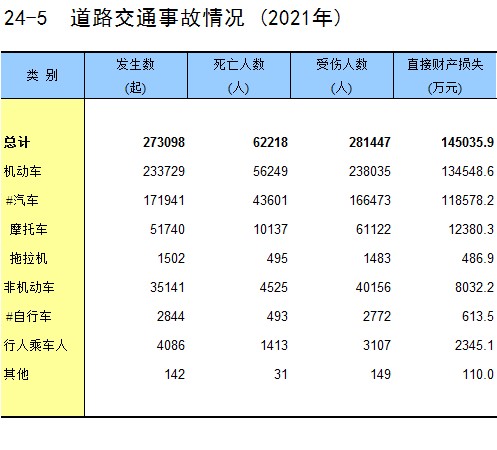
Seat belts must be worn in the back seat as well. In the same report, 60% of rear‑seat occupants killed in crashes were not wearing belts. The 45% and 60% figures are NHTSA estimates derived from crash‑database analysis (Kahane 2015), not from randomized trials. The Chinese death toll cited by WHO is a projection and is several times higher than official police statistics; the two figures cover different populations, so only the WHO estimate is used here.
Original references
Original bibliographic titles and links are preserved; some titles are in Chinese.
NHTSA (2024). Occupant Protection in Passenger Vehicles: 2022 Data (DOT HS 813 573):「Among killed passenger vehicle occupants with known restraint use, 48 percent of those in the front row and 60 percent of those in the second row were unrestrained.」https://crashstats.nhtsa.dot.gov/Api/Public/ViewPublication/813573 ; WHO (2025). Road traffic injuries fact sheet. https://www.who.int/news-room/fact-sheets/detail/road-traffic-injuries ; WHO GHO RS_196/RS_198 (China, 2021). https://ghoapi.azureedge.net/api/RS_196?$filter=SpatialDim%20eq%20%27CHN%27 ; 国家统计局 (2022). 中国统计年鉴 2022,表 24-5 道路交通事故情况(2021 年):死亡人数 62218 人. https://www.stats.gov.cn/sj/ndsj/2022/html/C24-05.jpg
Medical, legal, financial and policy conditions vary by person, place and time. Policy material primarily concerns mainland China; check the cited document and current local requirements.